This week's Art History 1 Neolithic to Bronze Age discussion got my dander up a bit because I didn't have ready answers to questions about skeletons of giants and evidence of Minoans in Michigan. But it didn't take long to uncover the sources of the mishegoss, so I thought best to share it on this quarter's first post to the assembled Parliament.
First off, the giant skeleton issue was easy to track down (keywords "giant" and "skeleton") because Snopes had already debunked it and that's the first place I usually look for answers to questions of this nature. Plain and simple, Folks: they're fake. I have several more sources if this doesn't suffice.
The second query was about whether or not archaeologists have found evidence of Minoans in Michigan, where they purportedly went to look for copper and left behind a tablet with writing on it. The BS factor here pops up immediately, too, because one might legitimately wonder how they'd even know there was copper there (even if they had any reason to know where "there" was), and one glimpse of the "tablet" shows that it's not Linear A. But hunt about I did, as promised, and now I'm really glad y'all asked, because I found a terrific blog by one smart dude that I'm going to head for first if this ever happens again.
For a straightforward treatment of this particular bit of silliness, read Jason Colavito's Review of America Unearthed S01E03: "Great Lakes Copper Heist." Not only does he clear things up elegantly, but he also solved the mystery of where you folks got the idea in the first place. So my next piece of advice is this: stay away from edutainment shows like America Unearthed or Secrets of the Dead (my comment on their Minoan/Atlantis episode is still on their website).
And just to show you that I'm not blowing smoke about how important garbage is to interpreting prehistory, I again defer to Mr. Colavito: Alternative Archaeology: Where's the Trash?
Homework assignment: download a copy of Carl Sagan's Baloney Detection Kit and carry it with you at all times. I know this is not your fault; most of you were educated in Texas, and I'll do what I can to make up for it.
Image credit: A bit of the "Marine Fresco" from Akrotiri (can you just imagine the Minoans heading to Michigan, out through the Gates of Herakles and across the Atlantic in these boats?). Via Wikimedia Commons.
Welcome, Members of Parliament
Welcome, Members of Parliament. This blog is designed to act as a student forum for anyone enrolled in my classes at a Dallas-area proprietary college, former students, and/or others who find our conversations interesting. The Parliament will be moderated to ensure civility and relevance. The directions we take, the paths we follow, and the concerns we address are all up to you.
Saturday, January 19, 2013
Monday, October 17, 2011
Caravaggio at the Kimbell
Art History 2/History of Art & Design II students might be interested in the Kimbell Art Museum's new blockbuster show, Caravaggio and His Followers in Rome, which started yesterday.Caravaggio was an absolute master at manipulating light and shadow, as well as creating the most dramatic of all possible interpretations of any biblical passage that inspired him--such as the Sacrifice of Isaac, above (1594-96), now usually housed in Florence's Uffizi Gallery.
For a review of the exhibition, see Scott Cantrell's article in the Dallas Morning News from last Sunday.
The upcoming formal analysis essay assignment provides as good an excuse as any to head to Fort Worth for this chance to see Caravaggio's work, and that of his contemporaries. His enormous influence is well represented in this show.
Monday, October 3, 2011
Paleolithic Children's Art
On my way home from work during the break, I heard about this cave, and these "finger flutings" on PRI's The World. Marco Werman interviewed an archaeologist (Jessica Cooney) who's been working in the "Cave of the Hundred Mammoths" in Rouffignac, Dordogne region, France--in the same general area as Lascaux Cave.
One of the things old folks like me actually enjoy is learning stuff we don't already know--and this was certainly a new one on me! I had never heard of Rouffignac, let alone the Mammoth drawings--nor anything called finger flutings (trailing fingers in damp clay to make designs).
I'll be bringing this up in the Art & Design I and Art History I classes this week, but thought some of you who are already beyond these classes might also enjoy learning something new.
Labels:
art,
cave painting,
children and art,
finger fluting,
Paleolithic
Sunday, September 11, 2011
Illumination and Mythography
Former student and app-designer extraordinaire, Alex Antonio, sent this link--having remembered, no doubt, what fun he had illuminating a manuscript for me: Art Student Hand-Illuminates, Binds a Copy of Tolkien’s Silmarillion. I'm not posting an image for copyright reasons, but the link takes you to the article. Make is a terrific magazine (in print or digital form), anyway--well worth noting for many reasons. I'm always happy to plug stuff I love to read.
Thursday, August 18, 2011
Drawing Lessons
The first installment, "Getting Back to the Phantom Skill" (September 10, 2010) discusses why he embarked on the twelve-part series, and introduces his plan. Scattered throughout the columns are examples from art history that show how skills develop and how artists have used them in the past. The series ended last December with "The Road to the Ten Unknowns," about McMullan's creation of a theater poster.
The Ashmolean Museum houses his teaching collection, and has a website devoted to The Elements of Drawing. The materials are vast (they include a video drawing lesson based on Ruskin's principles) and of interest to anybody who wants to learn to draw--or to draw better.
The book costs less than $10 in paperback; the only thing cheaper and that good is the McMullan series.
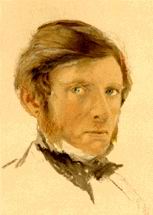
Image notes: The painting is John Ruskin in His Study at Brantwood, by William Collingwood (1881); the self portrait is watercolor touched with bodycolour over pencil, 1861. Both from Wikimedia Commons.
Monday, August 15, 2011
Endangered Alphabets
As many of you already know, I'm a lover of the word. Words, books, alphabets, languages--all aspects of reading and writing as a human cultural/technological activity fall under my owlish gaze.
So when I saw a review of Tim Brookes's Endangered Alphabets project, I was immediately intrigued, and got on board (a really awful pun, if you think about it).
Lovers of type and typography would do well to take a look at this, and contribute if you have any spare cash on hand. I've ordered the book and will share it with everyone when it comes.
Sunday, August 7, 2011
News, Newsreels, and Uncle News
For no particular reason, other than the fact that I'd been going through old photographs yesterday, it occurred to me to do a bit of research on an old family friend, Newsreel Wong.
Wong made a name for himself in the late '30s for a photograph he took (and possibly staged to some extent) of a baby on a Shanghai train platform.
What I didn't know was that he had been in New York City on July 28, 1945, when a disoriented pilot flew his Boeing B-25 Mitchell Bomber into the Empire State Building. Visiting the Hearst Metrotone offices early that morning, Newsreel Wong had been the only one in an office when the phone rang, and he answered it. He ended up commandeering a camera and headed to the site, where he was able not only to shoot the exterior of the building but got in to get film of the offices that were affected. The only other person who managed to gain access was Max Markman, who posed as a doctor, and shot the footage of the event included in this British Pathé newsreel.
A less sensationalized version of the coverage can also be found on YouTube, but I thought this highly edited bit was interesting for its embellishments. Since I'll be teaching the Visual Anthropology course in the Fall, this could provide some talking points about the role of the observer in the interpretation of events, and the impact editing has on the reception of information.
I don't know what happened to Wong's footage, but locating this particular event during an innocent search for a character from my past (he was known to my brother and me as "Uncle News" and lived near us on Yang Ming Shan outside of Taipei) amounts to a bit of the kind of synchronicity we've been talking about in the Myth class. As the tenth anniversary of 9/11 nears, this incident resonates eerily with more recent events.
One of the best blogs about media history I've ever found on the web is Amanda Emily's Feeding the News Beast: A Century of Tales from Behind the Lens. Her post on this event is the source of much of my information, and one on Wong himself explains how he got his nickname. Digital Video and Photography students ought to bookmark her site, because it's an endlessly informative record of visual news coverage.
Note: I'm posting this entry on both the Cabinet and The Owls' Parliament, due to its potential interest for a variety of audiences.
Labels:
Amanda Emily,
news media,
Newsreel Wong,
newsreels,
photography,
war coverage
Subscribe to:
Posts (Atom)