
I'm afraid I leaped up onto my soapbox to spout in the Tuesday afternoon class on the question of who built Egypt's pyramids and how. I'm a bit sensitive to this because I don't have much patience for uncritical thinking, but I also know that it's not my students' fault.
We're mired in a world so devoid of real imagination that even educators seem to think it necessary to hype "mysteries" and "secrets" in order to grab attention away from popular culture. In doing so, they've concocted something they call "edutainment," which has turned out to be neither educational nor particularly entertaining--at least to those who do the real work of archaeology.
So, for those of you who want to know how pyramids were built, two issues of
Archaeology's online magazine can shed some light on the ramp question:
How to Build a Pyramid, and
Return to the Great Pyramid. Both of these make hash of my claim that we
know how the pyramids were built; what I should have said is that we now have a pretty good
idea of how it was done, but the details are still unclear.

Since other fads involving space aliens also came up, I suggest a look at a really good article on the crystal skull craze, also from Archaeology:
The Skull of Doom. Many of you may find it way too long, tedious, "boring," or whatever, but it really delivers the goods. The
Wikipedia article on the topic is pretty informative, too, and contains a whole slew of resources for further research.
Some of my students have complained that I make studying some of these questions less intriguing--that it's more fun (entertaining?) to imagine all manner of wild stories. But that's a little like the argument against science in general: that studying and analyzing phenomena like the rainbow takes all the wonder out of life.
I can't for the life of me figure out how understanding the way light works when it hits a prism lessens the wonder of a rainbow. Doesn't knowing how the ephemeral display of light through raindrops splits the spectrum make it even cooler? The phenomenon is so fragile and momentary that appreciating its fleeting beauty makes it seem, to me at least, even
more wonderful (as in "full of wonder").
Does knowing how the pyramids were built make them any less amazing? I don't think so. Realizing how inventive folks were all those thousands of years ago inspires awe rather than extinguishing it. Human beings have been and still are screwing up right and left, but knowing that we do have our moments of glory is kind of reassuring.
But the real problem to me is that seeking mystery for its own sake indicates a gap in the human imagination. If we can only learn stuff if it's "entertaining" (or "mysterious" or full of "secrets"), we're in trouble. There are many aspects of life, the universe, and everything that we don't understand. But if we don't respect reason enough, we're doomed to remain swamped by ignorance and hype.
Students simply must learn how to distinguish the reasonable from the idiotic, the truly mysterious from the merely puzzling, and the expert from the charlatan. But please don't be afraid to ask questions; even if I hop back up on the soap box, we'll all benefit from your asking.
Real learning comes from wondering, and from developing strategies that help you find cogent answers your own questions.
Image credits: The lithograph of The Pyramids of Geezah is by Louis Haghe from an original drawings by David Roberts between 1846 and 1849; it's from the Library of Congress, but also available on Wikimedia Commons. The Crystal Skull photo (of the British Museum specimen) is from the Wikipedia article on the subject.

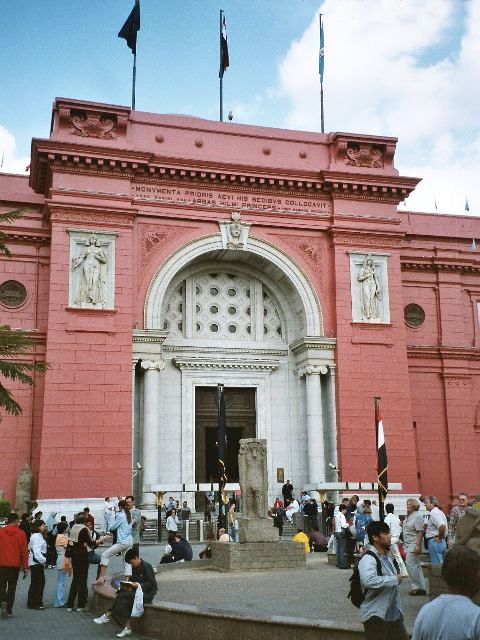 As I mentioned in a couple of classes last week, the Egyptian Museum in Cairo has not fared quite as well during and after the recent revolution as I reported a while back.


