For no particular reason, other than the fact that I'd been going through old photographs yesterday, it occurred to me to do a bit of research on an old family friend, Newsreel Wong.
Wong made a name for himself in the late '30s for a photograph he took (and possibly staged to some extent) of a baby on a Shanghai train platform.
What I didn't know was that he had been in New York City on July 28, 1945, when a disoriented pilot flew his Boeing B-25 Mitchell Bomber into the Empire State Building. Visiting the Hearst Metrotone offices early that morning, Newsreel Wong had been the only one in an office when the phone rang, and he answered it. He ended up commandeering a camera and headed to the site, where he was able not only to shoot the exterior of the building but got in to get film of the offices that were affected. The only other person who managed to gain access was Max Markman, who posed as a doctor, and shot the footage of the event included in this British Pathé newsreel.
A less sensationalized version of the coverage can also be found on YouTube, but I thought this highly edited bit was interesting for its embellishments. Since I'll be teaching the Visual Anthropology course in the Fall, this could provide some talking points about the role of the observer in the interpretation of events, and the impact editing has on the reception of information.
I don't know what happened to Wong's footage, but locating this particular event during an innocent search for a character from my past (he was known to my brother and me as "Uncle News" and lived near us on Yang Ming Shan outside of Taipei) amounts to a bit of the kind of synchronicity we've been talking about in the Myth class. As the tenth anniversary of 9/11 nears, this incident resonates eerily with more recent events.
One of the best blogs about media history I've ever found on the web is Amanda Emily's Feeding the News Beast: A Century of Tales from Behind the Lens. Her post on this event is the source of much of my information, and one on Wong himself explains how he got his nickname. Digital Video and Photography students ought to bookmark her site, because it's an endlessly informative record of visual news coverage.
Note: I'm posting this entry on both the Cabinet and The Owls' Parliament, due to its potential interest for a variety of audiences.

Sunday, August 7, 2011

Saturday, August 6, 2011
Tidying Up Art
In this week's History of Art & Design II class, I mentioned Ursus Wehrli's book, Tidying Up Art as a commercial example of parody. One of my students (sorry; can't remember who) said that he'd seen a TED talk by Wehrli, so I looked it up, and here it is.
Just in case you have a few minutes to spare, or need a break from studying for midterms.
Just in case you have a few minutes to spare, or need a break from studying for midterms.
Thursday, July 21, 2011
Design and Stuff
 For my first Summer quarter post, I was inspired by an article in Good about whether or not it's possible for designers to save the world without creating more stuff. Material objects are, after all, the focus of our design programs at AiDallas. What would to design mean if we weren't focused on creating objects?
One of the major revelations to come out of my first week of classes (and I don't know why this hadn't occurred to me before) was that in the ancient world, people made things carefully because they couldn't just go down to their local Buy More and get a replacement when something broke. There probably wasn't much garbage to pick up, because early economies weren't based on disposable objects. Everything was designed with its purpose in mind, and the designs (as we learn from Uhlmeyer's Rule of Technological Development #312) endured when technologies changed. That's why the early ceramic jugs in neolithic Turkey looked just like the baskets they had replaced as water carriers.
In our art & design history discussions during these first two weeks of classes, we've talked about the notion of "art for art's sake"--the nineteenth-century idea that "fine" art was qualitatively better than "applied" art because it was made for no purpose other than its beauty. But the Greeks and Romans made beautiful things that all had uses: funerary or heroic statues, painted pottery for drinking wine, temples for worshiping gods, etc. The words they used for art (techne and ars) both contained the idea that the objects be well-crafted, skillfully wrought.
Archaeologists love ancient dumps (middens) because they contain clues about the people who occupied the sites under study. But those dumps rarely contain objects discarded whole--only broken bits of things. Acoma Pueblo native Americans actually gather old potsherds to add to new pots made using traditional techniques, wasting nothing. In fact, the reason Indiana Jones isn't a believable archaeologist is that he just takes whole objects out of context--something no reputable scientist would ever do. The real guys in the safari hats get their kicks out of finding bits and pieces that can be put back together to give us an idea about what they originally looked like and what they were used for. Just about the only time we find collections of intact artifacts is when they've been buried by some disaster, like the eruptions of Mt. Vesuvius or Thera.
I hadn't realized before this week that the archaeology exercise my humanities students do (figuring out what random objects in a box might "mean") is more realistic than I'd imagined, because the stuff in the boxes is all twenty-first century junk: miscellaneous bits of useless crap randomly put together, just like what future archaeologists are going to find in our landfills. Cheesy little toys from Happy Meals, broken crayons, miscellaneous buttons, and junky jewelry are going to tell our story more potently than a museum full of art works.
In the opening photograph, all of the items pictured could be recycled; instead some idiot (or idiots) left them in a pine forest somewhere. The plastics will be there just about forever--and somebody designed every one of these objects.
So here's the question: how do fashion, interior, web, graphic, and other designers create without just adding more junk to the growing mounds of waste on this planet?
Image credit: Photo by Michelangelo-36, via Wikimedia Commons.

Tuesday, June 7, 2011
Spring Quarter Miscellany
Due to major lack of interest on my students' part, as well as lack of time on my own, I've neglected the Parliament for the entire quarter. Sudden needs for bonus points have emerged, however, and so to accommodate those who've been suddenly inspired to enhance their final grades, I'm offering up a couple of newsy bits that might be useful to some of you.
An old friend of my art and design history and humanities courses, Maggie Macnab (Macnab Design) recently presented a TEDx talk in Albuquerque, called "The Nature of Symbols." This should be interesting to anyone involved in design, advertising, branding, and any number of artistic pursuits.
I've frequently recommended Macnab's book, Decoding Design, to instructors and students alike, and her newest effort, Design By Nature, will be published later this year.
Here's one that goes to show you that taking art history classes might not be a complete waste of time. The Morgan Library & Museum in New York has launched an exhibit called Illuminating Fashion: Dress in the Art of Medieval France and the Netherlands, and the New York Times review of the show includes a nifty slide show with images from the featured manuscripts. Karen Rosenberg, who wrote the review notes that it "will teach you to scrutinize centuries-old manuscripts as you would a style magazine." For fashion history students, this approach seems made in heaven; not only can you find out what people wore when, but you might also be struck with inspiration for new and unusual designs based on centuries-old models. Aspiring rock singers could out-gaga Lady Gaga with information like this!
 For further inspiration, try perusing the manuscript illumination images on Wikimedia Commons, where I found the image of Queen Isabelle of France at left. It's a 15th century painting by a guy known as "the Boethius Master" for the Froissart Chronicles.
This will undoubtedly be my last (as well as first) post for the quarter, so I hope everyone has a splendid summer vacation. I think we all deserve a bit of time off after having slogged through 22 weeks with only a seven-day break in the middle, and a couple of holidays that may have done more harm than good. Be careful out there!
An old friend of my art and design history and humanities courses, Maggie Macnab (Macnab Design) recently presented a TEDx talk in Albuquerque, called "The Nature of Symbols." This should be interesting to anyone involved in design, advertising, branding, and any number of artistic pursuits.
I've frequently recommended Macnab's book, Decoding Design, to instructors and students alike, and her newest effort, Design By Nature, will be published later this year.
Here's one that goes to show you that taking art history classes might not be a complete waste of time. The Morgan Library & Museum in New York has launched an exhibit called Illuminating Fashion: Dress in the Art of Medieval France and the Netherlands, and the New York Times review of the show includes a nifty slide show with images from the featured manuscripts. Karen Rosenberg, who wrote the review notes that it "will teach you to scrutinize centuries-old manuscripts as you would a style magazine." For fashion history students, this approach seems made in heaven; not only can you find out what people wore when, but you might also be struck with inspiration for new and unusual designs based on centuries-old models. Aspiring rock singers could out-gaga Lady Gaga with information like this!
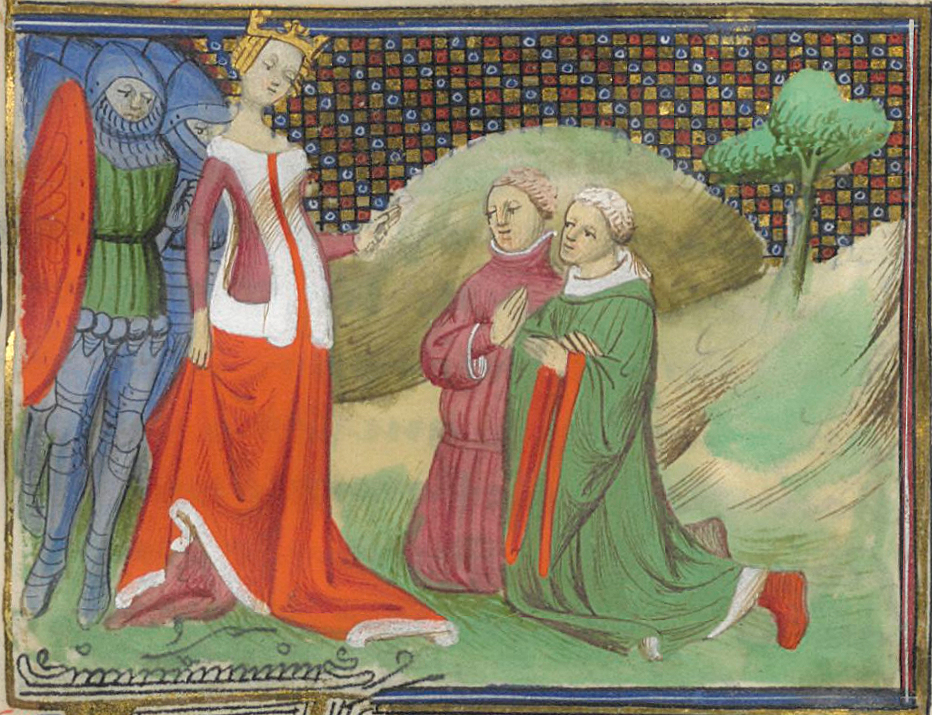 For further inspiration, try perusing the manuscript illumination images on Wikimedia Commons, where I found the image of Queen Isabelle of France at left. It's a 15th century painting by a guy known as "the Boethius Master" for the Froissart Chronicles.
This will undoubtedly be my last (as well as first) post for the quarter, so I hope everyone has a splendid summer vacation. I think we all deserve a bit of time off after having slogged through 22 weeks with only a seven-day break in the middle, and a couple of holidays that may have done more harm than good. Be careful out there!
Sunday, April 17, 2011
This Just In
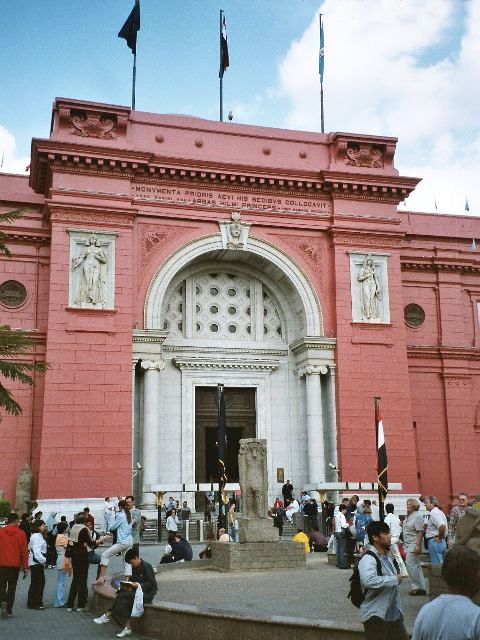 As I mentioned in a couple of classes last week, the Egyptian Museum in Cairo has not fared quite as well during and after the recent revolution as I reported a while back.
Rather, significant looting seems to have taken place, not only at the museum itself, but in storehouses elsewhere. The editorial by the president of the Archaeological Institute of America in this month's issue of Archaeology includes a plea for public support in helping to recover lost items. The heretofore indomitable Zahi Hawass has resigned in protest over the incidents.
Some of the objects seem to have been returned, as reported by the Huffington Post and other sources, so perhaps the publicity is doing some good. The article also refers to Hawass as having been re-appointed.
By all means visit the Archaeology website, especially if you're enrolled in my Humanities class this quarter, and check out the piece on Diving Ice Age Mexico. We'll be talking about the Maya later in the quarter, and this article contains some interesting material.
Wednesday, March 9, 2011
Geometry, Art, Pi, and Pie
 Now that the faithful are hung over from Mardi Gras, and walking around with ashes on their foreheads, I thought I might introduce another holiday that won't require breaking any Lenten Fasts: Pi day, March 14 (3.14). Here's hoping you haven't given up pie for Lent.
I'm fond of pimping general studies classes of any variety, not just my own, so I pay attention to my monthly newsletters from the Annenberg folks (the ones who bring us Invitation to World Literature and Art Through Time). They have a nifty website on math in the real world: Math in Daily Life, with interactive pages designed for school-age kids. Let's face it, though; most of us have forgotten what we learned about math anyway--even if you managed to squeak through College Algebra or Creative Geometry just last quarter. If you're unclear on the notion of pi, check out the page on that. There's even a segment on math and interior decorating and another on cooking.
If you think math is essentially irrelevant to artists, consider the importance of geometry in art and architecture, explored in this unit from a course on the topic at Dartmouth: The Circle, The Wheel of Fortune, and the Rose Window. The image that opens this post is the south transept Rose Window from St. Denis (via Wikimedia Commons). Some of you may remember (depending on how you spent Fat Tuesday) that we've recently visited St. Denis in History of Art & Design I.

Google even gets in on the fun (this is from last year):

If you still don't believe me, and won't until you see actual proof that such a holiday exists, there is also a Wikipedia page.
I especially love this tee-shirt I pinched from Wikimedia Commons; you can find it and other appropriate festive attire at Thinkgeek.com.

 Unfortunately, Pi Day falls on a Monday this year (I'm not on campus Mondays), so I won't be bringing pie to class. You'll have to wait for cookies on finals day.
Tuesday, March 1, 2011
TED 2011: The Rediscovery of Wonder
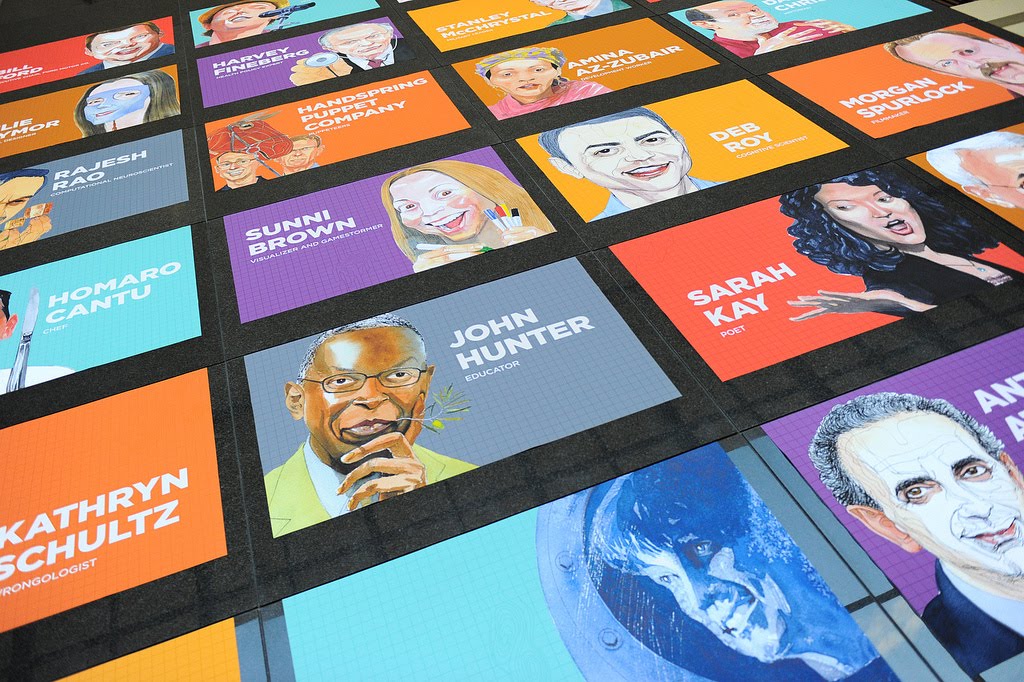 Time to check in on TED to see what's coming up at the annual conference that started yesterday. The focus this year is on wonder, which--as anybody who's ever sat in any of my classes for more than five minutes knows--is the beginning of philosophy. But it's also the beginning of creativity, because curiosity is one of the primary characteristics of creative people. The blurb on the site offers a preview:
For 2011, we are assembling a cast of characters capable of stirring the imagination as never before. Explorers, storytellers, photographers, scientific pioneers, visionaries and provocateurs from all parts of the globe. And we won’t be forgetting the other, harder-edged meaning of wonder -- where “I wonder” equals “I ponder.” We’ll be adding in strong servings of thoughtful insight, so that the possibilities we dream of are anchored in reality.
Not many of us have the 500 smackeroos it costs to "attend" the conference online, but a peek at the schedule will give you an idea of what we can look forward to over the next couple of years, since the annual conferences are where the posted videos come from.
The talks are arranged by sub-topic ("Worlds Imagined," "Beauty, Imagination, Enchantment," "If Only, If Only"), and include speakers who're identified (among many others) as physicists, artists, filmmakers, photographers, bone diggers, and (my favorite) a "wrongologist."
Kathryn Shulz, author of Being Wrong: Adventures in the Margin of Error (she has blog, too: The Wrong Stuff), will be one of the speakers. As will Bill Gates, Julie Taymor, film critic Roger Ebert, New York Times columnist David Brooks, and singer Bobby McFerrin.
Shulz is particularly interesting to me because I'm a faithful practitioner of the art of being wrong. I absolutely love it when I get it wrong. Maybe not so much as when I occasionally get things spot on, but I've always preached that one should embrace the process rather than the product. Being wrong leads us toward getting it right in the end, and stirs up our creative juices like like a shot of jalapeno juice in a fruit smoothie.
Not that simply trying is enough. I certainly don't fall into the "it's the effort that counts" camp. Rather, being wrong means you've not only tried, but that you've gotten somewhere. Maybe not where you wanted to get--but to a place from where you can begin to map out a new path. The first solution isn't always the best, but you learn from doing the work to get to it. That's why I like to call projects for my classes "problems," because all the possibilities aren't always apparent when you start, and there is seldom only one solution that works.
May I take this opportunity to request, however, that when you embark on said projects, that you take the time to read the instructions carefully, and design a plan of attack. That way, you can direct your energy toward potentially fruitful outcomes. Even if your plans don't work out exactly as you expect them to, you may be pleasantly surprised in the end. Not only that, but you'll have something suitable to turn in week 10.
Image credit: I hope this is legal. I pinched it from the "photos" section of the TED site. It depicts some of the featured speakers.
Subscribe to:
Posts (Atom)